Thursday, May 3, 2012

Then The Little Dinosaur Jumped Up And Ran At Us

The State of Oklahoma has an official reptile.  It is the Mountain Boomer, a.k.a. Collard Lizard (Crotaphytus Collaris).

Adopted in 1969.
Collared Lizard (Mountain Boomer) Crotaphytus collaris. The Mountain Boomer, or Collard Lizard, is a pretty turquoise blue collar except for its head and neck, which is bright yellow with black stripes along its neck. It was adopted in 1969 as the Oklahoma State Reptile.

Say what?  I never saw one like that.
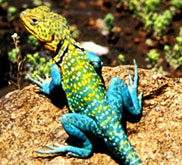

Key Characters: Large head; narrow neck; long, round tail; two black collars on the back of the neck.

Similar Species: A distinctive species not easily confused.

Subspecies: Eastern collared lizard, C. c. collaris.

Description: A large (up to 35 cm TL), green, blue-green, or straw yellow lizard with a light belly and an orange or yellow throat. Back usually covered with small light spots (except in juveniles, which have dark crossbands). Male much brighter than female.

Habitat: Bluffs, rock ledges, and rocky forest openings (glades).


Natural History: This lizard looks like it would be more at home in the deserts of Arizona than in Illinois. Male frequently sits on the top of the highest rock in its home range as if to advertise its presence. Mating takes place in the spring and eggs are laid in late June to July. Clutch size is normally 3-10 eggs and the hatchlings (ca. 9 cm TL) appear in August or September. Collared lizards feed on insects (especially grasshoppers) and small lizards. The main predators are snakes and hawks.


Kingdom

 Animalia -- animals
PhylumChordata -- chordates
ClassReptilia Laurenti, 1768 -- répteis, reptiles, Reptiles
OrderSquamata Oppel, 1811 -- Amphisbaenians, amphisbènes, lézards, Lizards, serpents, Snakes
SuborderIguania -- Iguanas, iguanes
FamilyCrotaphytidae -- Collared Lizards, Leopard Lizards
GenusCrotaphytus Holbrook, 1842 -- Collared Lizards

Crotaphytus collaris (Say in James, 1823) -- Collared Lizard, Eastern Collared Lizard, Lagartija-de collar común


l OK maybe some mountain boomers are turquoise some parts of the year, maybe.
But, I looked at all the official State images of the Boomer.  They all show a multi-color lizard laying on a rock.  That is not a Mountain Boomer, not any Mountain Boomer I've seen.


My Mountain Boomer would jump up and run on his rear legs with his tail out straight. (20 years late they would decide that's how real dinosaurs ran).  My Mountain Boomer is brown and dark brown and tan and lives in the boulders of the Wichita and Quartz Mountains in SW Oklahoma.  He will run at you with his mouth open.  He runs upright on two legs.

Where is this Oklahoma symbol?  How did it get lost.


Wednesday, April 25, 2012

To Live Well


As a young man my world was expand by a big table radio that sat on a table next to an easy chair in our kitchen a million miles from civilization.  Among those shows that transported me to far away places was the Lone Ranger.

Hi-Yo, Silver! A fiery horse with the speed of light, a cloud of dust and a hearty "Hi-Yo Silver"... The Lone Ranger! With his faithful Indian companion, Tonto, the daring and resourceful masked rider of the plains led the fight for law and order in the early Western United States. Nowhere in the pages of history can one find a greater champion of justice. Return with us now to those thrilling days of yesteryear. From out of the past come the thundering hoof-beats of the great horse Silver. The Lone Ranger rides again!

There were 2956 radio episodes of the Lone Ranger.  I think I heard them all, as well as all the television shows and movies that came out as well.  I even had a copy of the Lone Rangers creed that I lost when we moved when I was 10.  I found it again just a while ago on the internet.

 I believe...
that to have a friend, a man must be one.
that all men are created equal and that everyone has within himself the power to make this a better world.
that God put the firewood there, but that every man must gather and light it himself.
in being prepared physically, mentally, and morally to fight when necessary for that which is right.
that a man should make the most of what equipment he has.
that 'this government of the people, by the people, and for the people' shall live always.
that men should live by the rule of what is best for the greatest number.
that sooner or later...somewhere...somehow...we must settle with the world and make payment for what we have taken.
that all things change but truth, and that truth alone, lives on forever.
in my Creator, my country, my fellow man.
---John Francis Reid (The Lone Ranger)

It is not so much that I ever actually memorized the creed as I absorbed it into the mind through all of its example in the stories.

Of course it all blended together with the Ten Commandments and the Beatitudes and the philosophy of Captain Kangaroo. 

So this is the way I decided to live.  Like every good Lone Ranger I didn't do it perfectly, or even most of the time.

As I grew up I also found that it was not so wise to wear a mask and ride a white horse while you followed that creed.  So it was that when I read  Descartes I picked up on my over arching concept to live by even as a Lone Ranger:


               “I desire to live in peace and to continue the life I have begun under the motto:   'To Live Well You Must Live Unseen” 

― René DescartesThe Principles of Philosophy

Friday, April 20, 2012

A Meeting I Did Not Attend

The window was completely blown out.  The desk was upside down and the legs were splintered.  The small round conference table was blown up against the wall smashing two of the chairs around it.Paper was everywhere. The walls were peppered with shards and bits of glass from the windows. There were bloody hand prints on the walls next to the office, they led down the hallway.

I was looking at the room because I was the Agency's Emergency Coordinator.  A job nobody had wanted, but one I was relieved of the next day so people better situated to help, could take over. But that morning I was there looking for two employees that were unaccounted for.  We found one safe later and the other had been already transferred to a hospital.  A fireman and I search every room until another ranking fireman ran me out and sent him on to another task.

The room I described had special significance for me.  Up until 8 a.m. that morning  I was scheduled to be in a meeting at that room at that table at 9:00 that morning.  But the test company representative had made an agreement with the head of the division the night before and had gone home early.  So both the division head and I were at the main office doing other things when the bomb went off.  Five minutes latter we were downtown counting employees at the designate out of office emergency meeting place and making sure our people got medical help.  Then I was headed into the building to find the two not accounted for.

That was on April 19, 1995.

(Comments are disabled for this post)

Wednesday, April 18, 2012

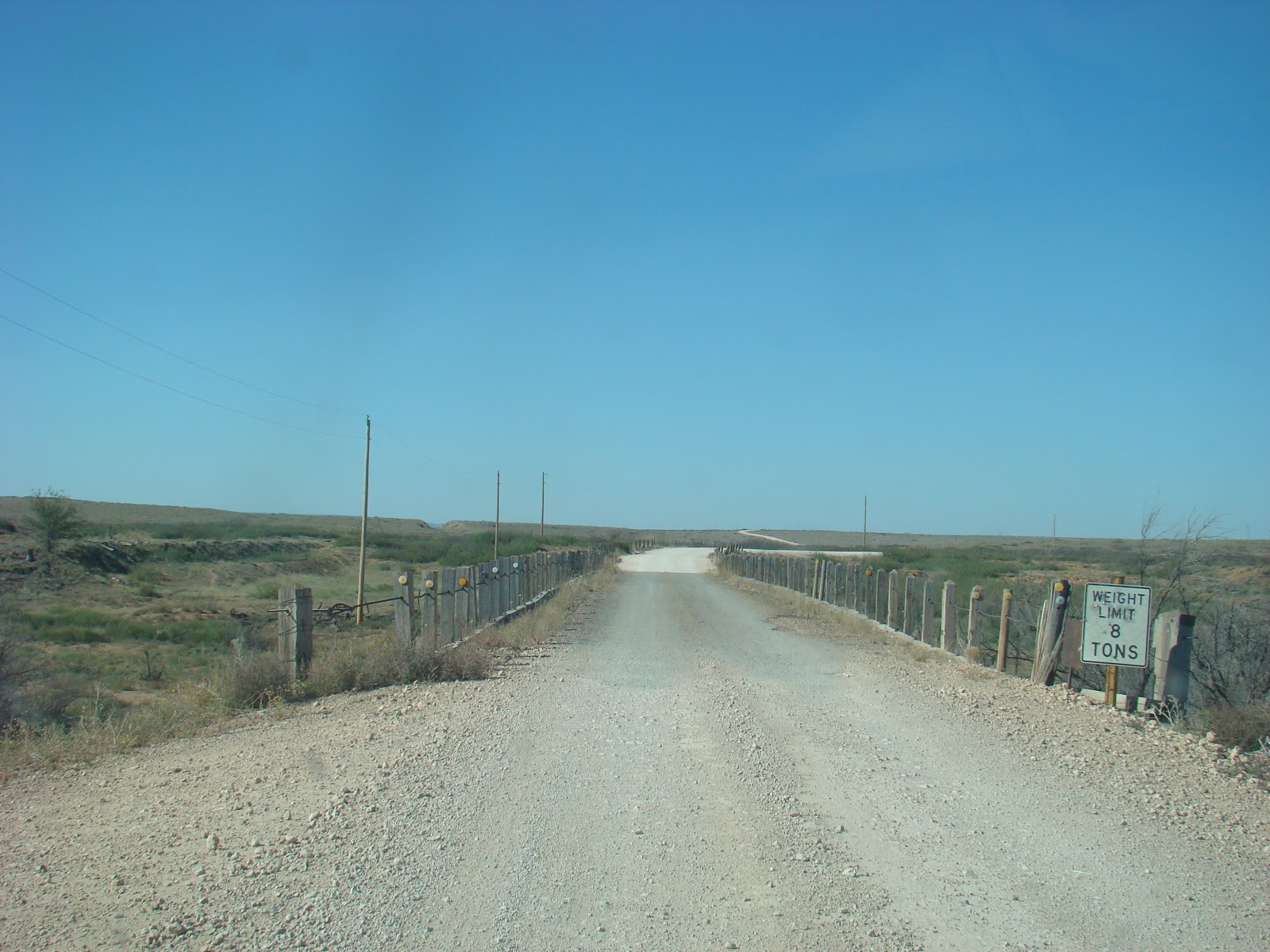
New Mexico 1928 Route 66 from Glenrio to San Jon Along The Frisco RR


This old stretch of Route 66 has got it all.  It is the original gravel road.  It has ghost towns.  It follows a fallen flag railroad, the Rock Island, and it has wild life.  Did I mention an upside-down tree and longhorns?


"Glenrio is located in extreme northwest Deaf Smith County, Texasand along the eastern border of Quay County, New Mexico.
To get to Glenrio, while traveling west along I-40, you will take exit 369 off of I-40 (Endee exit), turn right at the stop, and left onto the north frontage road.
When traveling eastbound on I-40, you can take the Bard Exit 361. Note that the majority of the road from Bard to Glenrio is dirt and gravel."   Source of text:http://www.legendsofamerica.com/tx-glenrio2.html


"Straddling the border between Texas and New Mexico is the forgotten ghost town of Glenrio. Once a monument along the boom and bust highway of Route 66, it now remains home to only the critters and the blowing tumble weeds of the vast prairie."

"In 1901 the Chicago, Rock Island and Pacific Railroad came through the area and two years later Glenrio was born. The name Glenrio, which stems from the English word "valley” and the Spanish word for river, is neither in a valley nor along a river."


"A post office was established on the New Mexico side of the community, but the mail arrived at the railroad depot located on the Texas side. Sitting in its precarious location crossing Texasand New Mexico, Glenrio became the subject of a long battle between both states for tax rights."


The last Motel in Texas and the First Motel in New Mexico, unless you are coming from the other way.  Texas is on the right side of gas station/office door and New Mexico is on the left side.


"By 1920 Glenrio had a hotel, a hardware store, and a land office, as well as several grocery stores, service stations, and cafes. A newspaper, the Glenrio Tribune, was published from 1910 to 1934. There were no bars on the Texas side of the community, since Deaf Smith County was dry, and no service stations on the New Mexico side because of that state's higher gasoline tax."


Longhorns are occupying the Railroad grade of the old Rock Island Line that runs parallel to Route 66 along this stretch.


They provide a dis-incentive to hunt for R.R. relics along the right of way.


"In 1905 the region was opened to small farmers, who settled on choice 150-acre plots and a year later the Chicago, Rock Island and Gulf Railway established a station at Glenrio. The settlement began to bustle with cattle and freight shipments. Initially the area was primarily populated by large cattle ranches but as time passed much of the surrounding land was planted in wheat and sorghum and the farming expansion was responsible for most of the growth of the area population."


  "Five miles past Glenrio is the ghost town of Endee, New Mexicowhich had a population of 110 in 1946. Along the way you can view several abandoned homes and structures before arriving at Endee."


This old Endee Motor Court sits south of I-40 on original Route 66, now a dirt Road. 


"Continuing down this old dirt road to Bard, you will see the remains of an old Rock Island trestle. The settlement of Bard was also said to have been a wild town during the cowboy days, where drunkenness and shootouts were commonplace. In the 1940's it was a trading center for local ranchers, consisting of a store, a gas station and several houses."


"Continuing west on old Route 66, the dirt and gravel road will take you all the way to San Jon, if road conditions permit."


P.S.  If it is wet or looks like rain, don't do it. Save it for a dry day.

Monday, April 16, 2012

No Sympathy For The Devil

“No sympathy for the devil; keep that in mind. Buy the ticket, take the ride...and if it occasionally gets a little heavier than what you had in mind, well...maybe chalk it off to forced conscious expansion: Tune in, freak out, get beaten.” 
― Hunter S. ThompsonFear and Loathing in Las Vegas: A Savage Journey to the Heart of the American Dream

Thursday, March 15, 2012

It Is Time Again To Chose Up Sides

I might have told some of this story before, cause there are lots of parts to it, and not all of them will be here. I have in my collection of things to finish, a project that contains a metal stencil for a sign from a Santa Fe Rail Road Station in Northern Oklahoma.  It was a small station with one waiting room. The stencil reads "Whites Only". It was used to make the sign on the waiting room door.  If you were not White, you had to sit outside on a bench at the loading dock of the station.  Not White meant Indians, Mexicans, but most especially Negros.

I have taken that stencil  and have pasted a picture on it in such a way that when I cut out the letters most of the picture can still be seen.  There's where the projected stopped.  Still haven't figured out what comes next.

The picture was taken in Indiana in 1930.  It is almost like a town festival.  everybody seems to be there, well all the White people are there.


I am from that culture. No not Indiana, the culture that kept Negro's in their place and segregated; the culture that, if it wanted to, could punish them for being uppity and Black at the same time.  I remember it.  The segregated cafe's, rest rooms, and drinking fountains or on a work site, one water bucket for Whites and one for Them. It did not seem strange.  It was the normal way things were done.


Even though we were segregated, I wasn't separated from the Negroes.  I worked in the fields with them when I got older.  I played with their kids when I was a kid and they were living in our nigger-shank during boll pulling time.  I was Naive with a capital N.  I knew what as going on but had not the foggiest notion of what it meant. When I was 15 I just happened to ride into town with a black man who had been helping me and my crop duster boss clean out his hanger.  He was just going to drop me off at my house.  Before we got there, a car passed us and some jerk stuck his head out of the window, and yelled at me by name, "f..... nigger lover".   The Black guy got real scared.  That was an epiphany for me, but I have to admit it took a couple of years to totally sink in.


Now we have a whole bunch of good solid people, citizens, that want to go back to those days for Blacks, and Mexicans, and Indians, and even for Women.  They want their America back.  No, they will tell you, that's not the America they want back.  Not that segregated one, they say, but that one where me and mine were respected.  Mind you they are good people, good Americans, our friends and neighbors and they don't have a clue as to what they are actually striving for  (some do, the bad ones).


We all have to chose which America we are willing to fight for.  If you sit on the fence on this one your wump won't survive, nor maybe even your neck.

Monday, March 12, 2012

The Spit & Whittle Club

The Spit and Whittle Club.......The club was about a half block from the city park.  It was in a small one room house under a Mulberry tree across the street from the County court house.  The old men sat on big apple crates, an old church pew set against the wall, and chairs liberated from several places.  They sat outside in the spring and summer. In the winter they sat inside around a big bellied stove fueled with coal from the nearby blacksmith shop.

Mr Mitchel, a man that my Dad farmed his place on the shares, was often there and he would be whittling stars, animals, and abstract geometric figures out of the sides and ends of produce boxes. He always used the small blade on his Barlow do do the cutting. When my dad stopped by to talk to him, I'd play in the park, and when we left Mr. Mitchel or one the other men would give me all the things they had whittled out that day.

My mother called it, "That Nasty Place" because most of the men chewed and would spit their tobacco into coffee cans sitting around on the ground.  Some mens' aim was better than others.  They didn't drink coffee at the club. They drank something with a brown sack wrapped tightly around it.  They would always offer my Dad a chaw or a sip.  He always said, no.  Dad was devout Baptist deacon, and thought that even going to the movies was a sin. Although he did roll his own with papers from a pocket can of Prince Albert.  Sometimes when we were through visiting, Dad and I would walk across the street and get a Dr. Pepper or an RC out of the Coke machine at the City Service filling station.