Monday, December 12, 2011

Books And The Stores That Sold Them

I did not come from a well read family. Indeed the only books in our house were the Bibles, Bible study books, and library books I brought home from school. I never owned a book (except the Bible and cover-less paper-packs from the drugstore) until I was a Freshman in College at Oklahoma Baptist University. I don't mean the textbooks, I mean a book I bought in a book store just to read. My first book was A Precociousness Autobiography by Yevgeny Yevtushenko. Following in that vein I bought a book of Frost's Poems and another by Emily Dickinson.

It wasn't until I was 21 and was in the Army and stationed in Washington D.C. for a year's training that I discovered real bookstores. I mean BOOK stores. Book stores that had all the new books. Book stores that had remainder books real cheap. Best all, bookstores that had old books, and better than that old cheap books. I was most certainly in an unknown corner of Heaven (about the same time I discovered neighborhood bars and ethnic foods).

Lower D.C. between G & K streets and 9th and 15th streets, had all sorts of used books stores at all prices. Georgetown had four of five used/antiquarian book stores which were my favorite. Then there was Lowdermilk's.

The year of my revelations was 1966-67. I made $115 a month as a PFC stationed at Fort Myers, Virginia. Each month I set aside $10 to go into town and buy one good meal from the variety of ethnic and national restaurants available. I set aside another $10 to buy books and pay for them to be mailed home to Oklahoma via "Book Rate" postage.

My first acquisition I still have. It was a first edition of "Poems" by Alan Seeger published by C. Scribners and Sons in 1916. For this I paid $1.25 from a book store Georgetown. As an additional bonus it contained a 2" X 3" book market used by the previous owner that was a funeral announcement in English noting So & So had died in Paris, France and when and where his funeral would be. It was dated 1838.

During the year I purchase several Hemingway first editions, the first edition of Dr. Zhivago in Russian published by the University of Michigan Press, and the collected works of Leonard Cohen (new). Also I bought a complete set of the Harvard Classics (1923 edition I think) and "My Seven Years In Tibet", first edition. In ten months, $100 worth of books and book rate postage. My parent to whom the books were being sent for safe keeping thought I had gone mad. Which I guess was true.

It started a life time of books. An affliction, I gladly note, from which I have never recovered.

Friday, October 7, 2011

Bones, Skulls, Skeletons, The Museum of Osteology


From comparative anatomy to classification to adaptation and locomotion, The Museum of Osteology has been designed with learning in mind. Currently displaying nearly 300 skeletons from all corners of the world, visitors have a unique opportunity to compare and contrast many rare species normally not seen in museum exhibits. In addition, The museum features a variety of North American specimens ranging from tiny mice and shrew skeletons to a 40 foot humpback whale.

(Click on each picture to greatly enlarge it)


All text is from the Museum of Osteology Site.
i

Exploring Oklahoma Museum of Osteology a One-of-A-Kind Treasure

s a unique educational experience. Focusing on the form and function of the skeletal system, this 7000 s(Click on each picture to greatly enlarge it)quare ft. museum displays hundreds of skulls and skeletons from all corners of the orld

The Museum of Osteology, located in Oklahoma City, Oklahoma, is a unique educational experience. Focusing on the form and function of the skeletal system, this 7000 square ft. museum displays hundreds of skulls and skeletons from all corners of the world. Exhibits include adaptation, locomotion, classification and diversity of the vertebrate kingdom. The Museum of Osteology is the only one of its kind in America.

Museum of Osteology

10301 South Sunnylane Rd.
Oklahoma City, OK 73160

Latitude 35.364829, Longitude -97.44172 (Google Maps)

From I-35,continue on I-35 until you reach exit 121B. Go east on I-240 for 3.3 miles. until you reachexit 7 (Sunnylane road). Head south for 1.7 miles until you reach the museum. We sit on the west side of the road. Hope to see you soon!

From I-40 west of Oklahoma City, Continue east on I-40 until you reach exit 147A, merge onto I-44. In 4.8 miles you will make a slight left and merge onto I-240. Continue on I-240 for 7.5 miles until you reach exit 7 (Sunnylane road). Head south for 1.7 miles until you reach the museum. We sit on the west side of the road. Hope to see you soon!

From I-40 east of Oklahoma City. Heading west as you come into Oklahoma City metro you will make a slight right onto I-240 W (signs for Lawton/Dallas). Continue on I-240 for 8.9 mile until you reach exit 7 (Sunnylane road). Head south for 1.7 miles until you reach the museum. We sit on the west side of the road. Hope to see you soon!

Phone: (405) 814-0006

E-mail: Info@MuseumofOsteology.org


Education is the number one priority of The Museum of Osteology. Here you will find useful information to enhance your visit. Feel free to download or print any of the educational ideas, curriculum, or diagrams on this page and use with your class or group. If you have any questions, comments or ideas you'd like to share, please do not hesitate to contact us ateducation@museumofosteology.org.


Cats
The family Felidae is comprised entirely of cats. There are approximately 41 species found throughout the world. Cats possess some impressive traits for hunting. Good vision, sharp retractable claws, and long slender canine teeth help to make cats some of the most effective predators in nature.


Horns or antlers found on a skull bear evidence of how an animal communicated, defended its self and possibly the animals sex. Animals can protect themselves or attack other animals by goring them with their horns or antlers. Bighorn sheep, muskox and deer use their horns or antlers for establishing territory and winning mates.


Giraffe


Flightless Birds
There are many species of flightless birds ranging from rails to penguins to the ostrich. Flightless birds evolved from birds that could fly but in areas where flight was not needed for survival. Flightless bird’s bones are more dense and heavier than flighted birds. With the exception of penguins, which have adapted to “flying” through the water, most flightless birds lack a keeled sternum for flight muscle attachment. These skeletal adaptations, along with the absence of flight feathers, permanently ground these birds.


Cyclopes


Humpback whale


Beluga whale


Barnacles on a live humpback whale.


Alligator


Beluga whale


Thursday, October 6, 2011

The Black Kitten Video and Final Disposition

On October 5th the little black kitten found a good and loving home.

The night before Doc tried to video a cute kitten to show the world what they were missing by not owning her.

Thursday, September 29, 2011

Fatman and the Cat: Or the Kitten Bests Dr. Lobo

This will go down as another family saga.

Day One: Mamma Bear is awakened by high pitched meows outside the window.
Mamma Bear is a Cat Lady (she has 4 cats, I say that qualifies her, she claims it takes 5 cats to qualify). Later in the day a tiny black kitten is observed hollering on the patio. Kitten runs under the door to the storage shed via the large crack that has not been repaired since 2004.

Day two. Same scene and scenario.

Day three: Mamma Bear flies off on an airplane (wanted to make that clear lest you think she had a rug or a broom) to see her daughter in Denver. Leaving Fatman and Dr. Lobo in charge of kitten capture operations.

Day four: Rather night four, Fatman chases kitten around the yard but said vermin is too small and too fast for him.

Day five: Dr. Lobo retrieves Hava-Heart live trap from his workshop and sets it up with cat food on trip plate. Here the real fun begins.


The trouble is that the kitten is very small and lite. So lite, that he eats all of the food off the trap trip and leaves the trap empty and un-sprung.


Fatman was once a farmer. So the farmer method is employed by him next.


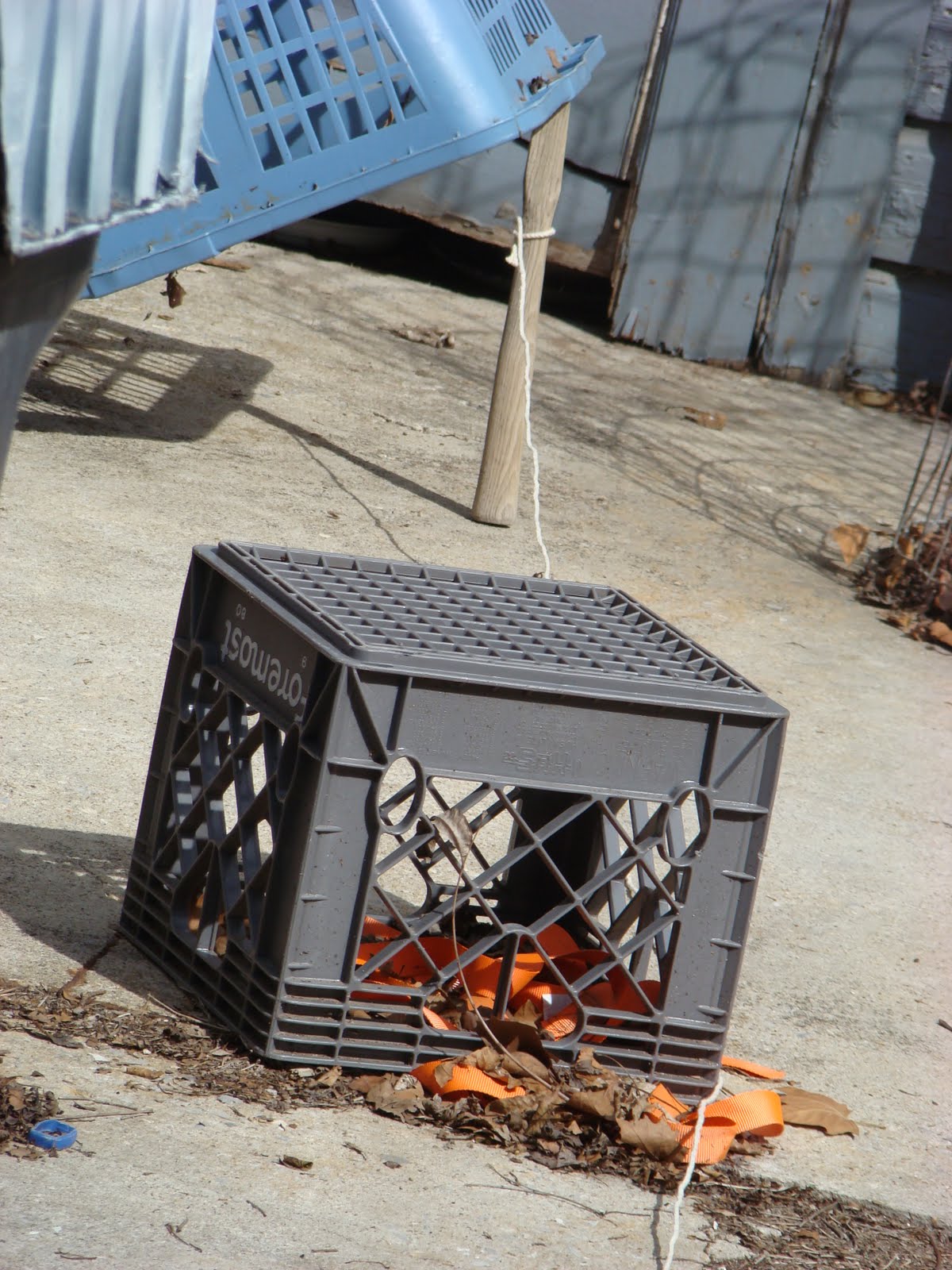
Yes, of course, he put cat food under a laundry basket propped up with an old hammer handle to which is tied a long string leading across the patio and through the kitchen door where he sat drinking a diet Dr. Pepper and waiting for the kitten to appear under the basket so he could pull the string and capture it.


First problem was the other cats. They like cat food too.


So he replaced it and set the trap again. The kitten appeared at the crack under the door, hissed and ran back into the shed.


But hunger overcomes caution.


The kitten gets bolder and comes closer to the trap.
Fatman pulls the string and the kitten jumps back and the basket misses.


Fatman tries two more times. On effort #3 he is successful. The kitten is trapped under the basket. But Fatman is fat and Fatman is slow. So as he is bent over attempting to extract the kitten from beneath the basket he falls over and the kitten escapes.


Finally Dr. Lobo comes back with a now well oiled and clean Hava-Heart trap and re-sets it with the food on the far side of the trip plate so the kitty will have to put more pressure on it. Success at last and kitty is caught and then transferred to the cat carrier jail cell prepared for it.


So after using a flea comb to remove 36 fleas from the baby cat, and a general clean up we have a five to six week old solid black female kitten.


Day seven: Dr. Lobo keeps the kitten until Mamma Bear returns. He fully intended to immediately take the cat to a no-kill shelter. Nope. We will keep her and find a home for her ourselves, says Mamma Bear (A.K.A. Okiebookwoman).


Day eight: Please, is there not someone person (acceptable to Mamma Bear) in the OKC area that wants a cute kitten?


Day ten: Will someone save me from the fifth cat please.
Please!

Thursday, September 8, 2011

Rail Fan No More

As I neared retirement one of the things on my To-Do List was to visit several active railroads in the United States and photograph trains. I had loved trains all my life, and since 1984 had actively engaged in in what's call in America as Rail-fanning. My children grew up chasing trains and waiting by the railroad tracks waiting for the right locomotive to come by so I could take its picture. Indeed my youngest child appears in hundreds of train photographs. In fact there are few pictures of him other than with a train. I used to stand by the tracks for hours at a time to get the shots I wanted. I have many albums full of train pictures I have taken, and box after box after box of loose pictures and negatives of trains.

I retired in January 2002. I didn't buy that pickup with a camper to go train chasing and camping out on trips to catch my favorite Santa Fe R.R. trains in classic places through out the West. In fact I have taken only a few train pictures since I retired. Things change it seems.

One of the consequences of 9-11 was that we began to see terrorist everywhere all the time. Every want-to-be little fascist realized their fondest dreams. Everybody was the enemy. So standing alone by a railroad track with a camera became risky business. Not only did every law enforcement officer that came by legitimately check on you, but many illegitimately told you it was not legal to do what you damn well knew was legal. But to argue with a cop is not wise, especially when they have an obvious tumescent ego involved. What was worse was the non-cop-non-railroad worker security people and general screwballs. People who had no business nor authority to even talk to you who were bound and determined to save America from your photography lest you be a terrorist or some fool who might give terrorist your pictures.

So my days of quite and solitude waiting by the railroad tracks on some windswept rock in Western America were no longer fun. In fact they actually seemed dangerous after a while. So I finally stopped photographing trains in the wild and have to content myself with those that are dead and on display or of those running free as I drive down the road with my windows down and camera inside the car secretly catching their image.

Wednesday, September 7, 2011

See Dick, See Jane, See Their Spot ?

Dick and Jane's Spot
Art for the heart, from the heart, in the heart of Washington
101 North Pearl St • Ellensburg,WA 98926


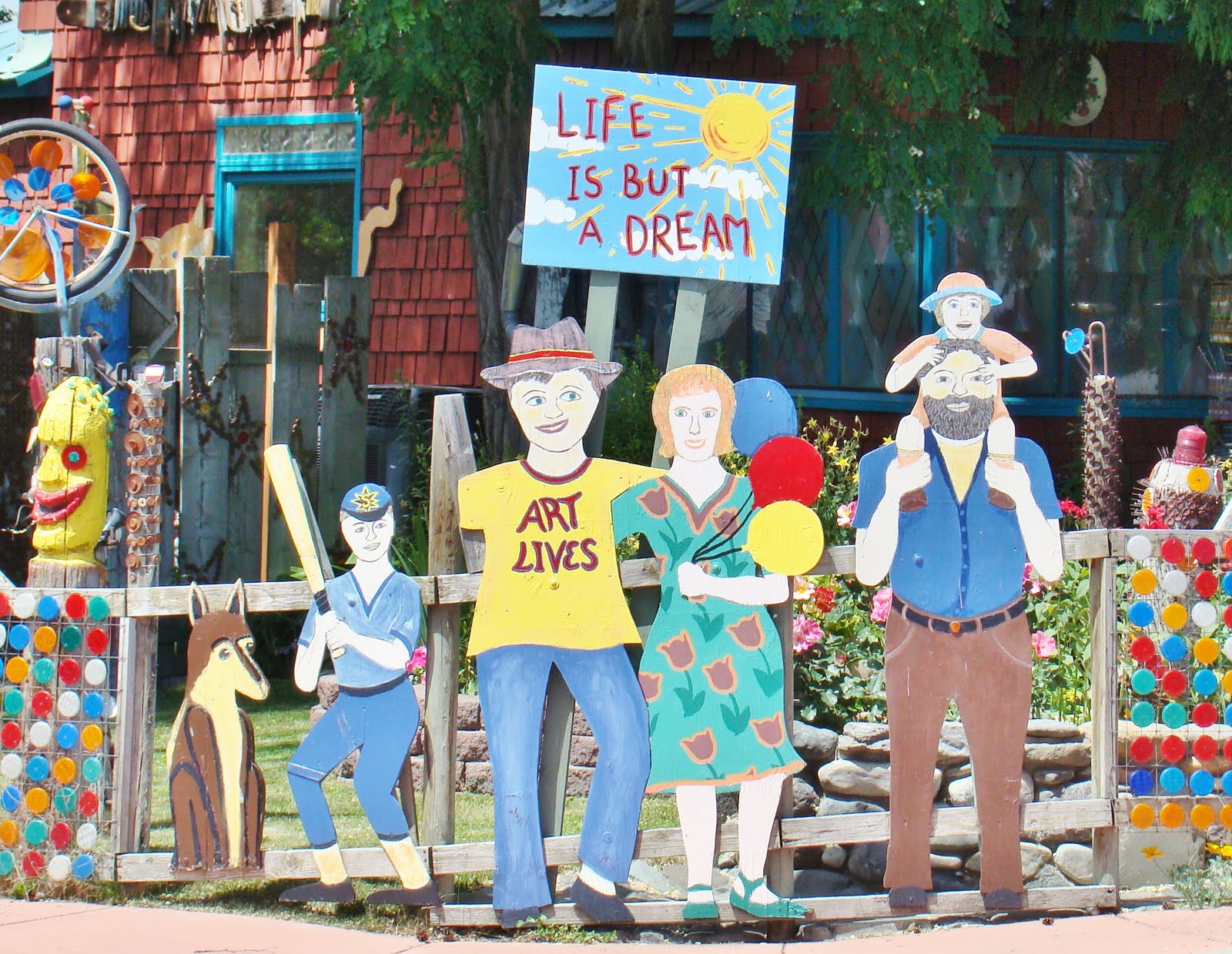
Serendipity is always welcome on a trip. You drive off the highway looking for a local cafe and then you run into Dick & Jane's Spot.


Caught a glimpse of it out of the corner of my eye as we drove into downtown. It was a block off the main street but I had to turn around and go see what it was. Wow! I could hear my wife's moans of regret.


Call it folk art, or assemblies, junk art, or a neighbors greatest nightmare, it is very very unusual.


Some of the most creative uses of everyday things I've seen.


So, how much of this can I use to inspire my own back-back yard creations?


All of it he says....


This is one of my favorites.


Yes. I have some bicycle wheels.


Old reflectors? Yep, got some of those.


Hub caps? Just so happens I have just about a dozen or so.


Now these i don't have. hummm...


I can do this one too.


Bottle caps? uhuh, I got 'em.


I'm going to need more wheels though.


Bottle trees yes, that's great.


May need more bottle caps too.


If I keep it all lower than my 7 ft fence the OKC Neighborhood Code Enforcement people will never see it. Beside it is freedom of speech, right?